India Under Pressure: Prospects for Political Stability by Robert L. Hardgrave Jr
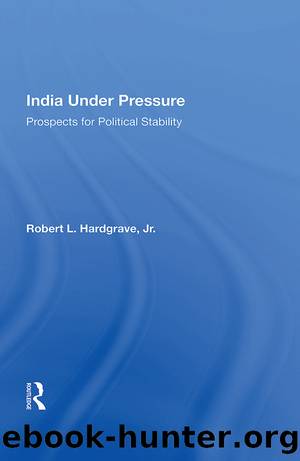
Author:Robert L. Hardgrave Jr. [Hardgrave, Robert L. Jr.]
Language: eng
Format: epub
Tags: Social Science, Political Science, World, Asian, Regional Studies
ISBN: 9780865318601
Google: YRGjDwAAQBAJ
Goodreads: 3181333
Publisher: Westview Press
Published: 1984-06-20T00:00:00+00:00
The Military
The military is the ultimate guarantor of stability in India. The Indian army, with nearly one million volunteers, is the worldâs fourth largest standing army, and its officer corps is respected, highly professional, and, by tradition, non-political. But pressure within the military, potential political instability, and the inability of civil authorities to cope with social unrest could draw the army into a more active role in government.
The social character of the Indian military is changing. Officers are increasingly recruited from a broader social base and from more humble backgrounds than the affluent families of martial tradition that were once the principal source of military leadership. As the culture of the officer corps changes, as it loses its Sandhurst character, it may also lose something of its non-political tradition.
The military has long been an effective lobbyist for defense expenditure, but officers more recently have been drawn into the political arena over the issues of pay, promotion, and retirement. Low pay is a source of discontent among officers, but it has also taken its toll in recruitment. A Lieutenant Colonel, for example, receives today approximately $270 per month, less than a third of what he took home in real income in 1947. At these levels, the military has been unable to compete with private sector employment opportunities, and, unwilling to lower its recruitment standards, the military now faces an officer shortage which is especially serious in those areas requiring engineering and technical skills.
But while there is a shortage of junior officers, there is enormous pressure at the upper levels for promotion to command rank. The bottleneck was widened somewhat recently by increasing the number of brigadiers, and a step up in pay grade is now possible without promotion in rank. But limited prospects for promotion, like pay, affects the militaryâs ability to attract the best recruits, and it is also a potential source of unrest among junior officers. One of the classic patterns of military coups in the Third World--though not in South Asia--is the seizure of power by colonels. This has typically involved junior officers of more humble origins who are frustrated in promotion, while the senior ranks remain the preserve of officers from affluent and socially prominant backgrounds. Such a social distinction is not now evident in the Indian officer corps, but the changing base of recruitment together with limited promotion to command ranks could bring it about.
Promotions also raise the sensitive issue of political interference. The military has been highly protective of its internal affairs, and for the most part this has been respected by civil authorities. The Government, however, has the right to choose the Army chief of staff from among the senior generals. This has, with two notable exceptions, followed the principle of seniority. In 1975, in an appointment with political overtones, Mrs. Gandhi named Lieutenant General T. N. Raina to the top post, superseding the senior officer. In June 1983, she again stirred controversy by selecting Lieutenant General A. S. Vaidya over his senior, Lieutenant General S.
Download
This site does not store any files on its server. We only index and link to content provided by other sites. Please contact the content providers to delete copyright contents if any and email us, we'll remove relevant links or contents immediately.
| Anthropology | Archaeology |
| Philosophy | Politics & Government |
| Social Sciences | Sociology |
| Women's Studies |
The Secret History by Donna Tartt(19086)
The Social Justice Warrior Handbook by Lisa De Pasquale(12190)
Thirteen Reasons Why by Jay Asher(8909)
This Is How You Lose Her by Junot Diaz(6886)
Weapons of Math Destruction by Cathy O'Neil(6279)
Zero to One by Peter Thiel(5801)
Beartown by Fredrik Backman(5754)
The Myth of the Strong Leader by Archie Brown(5507)
The Fire Next Time by James Baldwin(5442)
How Democracies Die by Steven Levitsky & Daniel Ziblatt(5218)
Promise Me, Dad by Joe Biden(5153)
Stone's Rules by Roger Stone(5087)
A Higher Loyalty: Truth, Lies, and Leadership by James Comey(4962)
100 Deadly Skills by Clint Emerson(4925)
Rise and Kill First by Ronen Bergman(4788)
Secrecy World by Jake Bernstein(4753)
The David Icke Guide to the Global Conspiracy (and how to end it) by David Icke(4717)
The Farm by Tom Rob Smith(4507)
The Doomsday Machine by Daniel Ellsberg(4490)
